Information verified July 2026. ICF can update credentialing requirements and exam content, so check the official exam page and any instructions sent directly to you before your appointment.
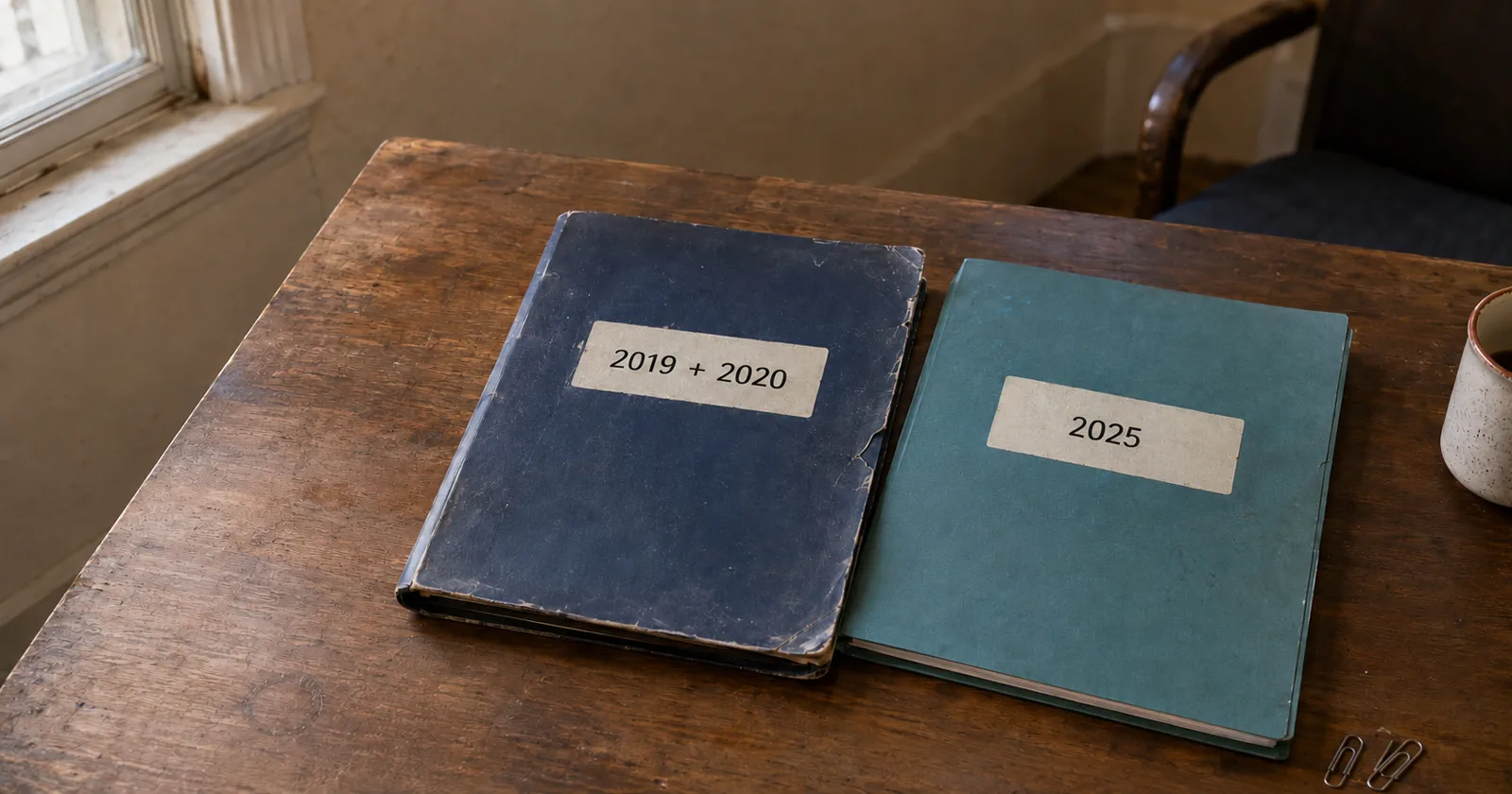
ICF has published four official documents. The standard exams test two of them. The profession runs on the other two. A PCC/MCC pilot uses the newer pair, which is why you need to know which exam you are taking. Nobody put all of that in one sentence on one page, so I just did.
Here are the four:
- The 2019 ICF Core Competencies
- The 2025 ICF Core Competencies
- The 2020 ICF Code of Ethics
- The 2025 ICF Code of Ethics
Every few weeks I hear from a candidate who has been studying the wrong pair for the standard exam. Usually the newer pair, because it looks current, because it is current. They are learning the right profession and preparing for the wrong exam.
If that is you, you did not miss something obvious. The standard exam and the profession are temporarily working from different editions, and ICF does not exactly lead with that.
The short answer:
If you are taking the standard ACC or PCC written exam in 2026, study the 2019 ICF Core Competencies and the 2020 ICF Code of Ethics. If you are coaching in 2026, you also follow the 2025 standards. If ICF invited you into the PCC/MCC exam pilot, follow the pilot materials sent to you; that pilot uses the updated competencies and ethics code.
You are not picking which framework is legitimate. You are doing two different jobs. Candidate is one. Coach is the other.
What the exams actually test
As of July 2026, ICF tells candidates taking the standard exams to study the 2019 ICF Core Competencies.
Same story with ethics. The 2020 ICF Code of Ethics stopped being the profession's current code over a year ago. It is still the version the standard exams test.
Meanwhile, the 2025 ICF Core Competencies are the current framework, and the current Code of Ethics took effect April 1, 2025.
| What you are preparing for | Core Competencies | Code of Ethics |
|---|---|---|
| Standard ACC written exam | 2019 version | 2020 version |
| Standard PCC written exam | 2019 version | 2020 version |
| PCC/MCC exam pilot | Updated version | Updated version |
| Coaching actual clients | 2025 version | 2025 version |
This article covers the standard written exams. Performance evaluations, mentor coaching, and application requirements are separate machinery with their own criteria. If ICF has invited you into the pilot, the instructions sent directly to you take priority over this article.
Same documents. Different exams.
Standard ACC and PCC candidates study the same editions. That is where the similarity ends.
The ACC Exam tests knowledge. Definitions, boundaries, ethics. One correct answer.
The standard PCC exam, officially the ICF Credentialing Exam used for PCC and MCC candidates, tests judgment. Four plausible actions. You select the best and the worst.
An ACC candidate needs to identify the correct principle. A PCC candidate needs to tell four principles apart while they are all wearing the same outfit.
The ACC Exam
The ACC Exam is 60 multiple-choice questions. Four options, one correct response.
Three content areas:
- 30% Coaching Ethics
- 30% Definition and Boundaries of Coaching
- 40% Coaching Competencies, Strategies, and Techniques
Read that again. Ethics and boundaries are 60% of the exam. Most candidates spend most of their time memorizing the eight competency names. The math does not support that plan.
What the exam actually wants you to know:
- What belongs in a coaching agreement.
- How coaching differs from consulting, mentoring, training, therapy, and counseling.
- When a referral is appropriate.
- What confidentiality protects and when disclosure may be required.
- How to handle a conflict of interest.
- Which strategy fits which situation.
- What is not your job as a coach.
The distractors are not stupid answers. One sounds compassionate but wanders past the coach's competence. One sounds careful but ducks an ethical obligation. One describes something useful that belongs to mentoring.
This is why version control matters at the ACC level. You are learning terminology and definitions with precision. If your study guide quietly blends editions, you are memorizing a document that does not exist.
The PCC Exam
The standard ICF Credentialing Exam works differently.
Seventy-eight situational-judgment items. Each one gives you a coaching situation and four actions. You pick the best and the worst. Several will sound reasonable. That is the point.
Here is a constructed practice item, the kind I use with candidates. It is not an official ICF exam question. A client says:
"I have considered every option. I just want you to tell me which one you think is best."
Four responses:
A. The coach shares which option they believe is strongest, with reasoning.
B. The coach explains that coaches never give opinions and redirects the client to their own thinking.
C. The coach explores what the client wants from the coach right now and how the client wants to make the decision.
D. The coach reassures the client that they already know the answer and just need to trust themselves.
Every one of these gets said in real sessions every day. Here is how I score them.
C is best. It treats the request as information instead of a problem. It goes back to the relationship and the agreement. The client keeps the decision. The coach stays in it.
A is worst. It is also the nicest-sounding one, which is exactly the trap. In consulting, A is the job. In coaching, A does the client's thinking for them. That is the most direct partnership violation on the board.
B and D are the middle. B protects agency by lecturing about it. D sounds warm and smuggles in an assumption the coach has no evidence for.
Notice what happened. The worst answer was the most helpful-sounding one. I see this constantly when reviewing PCC-level work. The weakest response is rarely cold. It is warm, smart, practical, and it quietly takes the client's thinking away.
You cannot memorize that instinct. You practice it.
Why hasn't the standard exam moved to 2025?
Because a validated exam is not a webpage.
Questions, answer keys, scoring, and passing standards were built together as one calibrated instrument. Change the source documents and the assessment has to be evaluated with them. That takes time.
ICF has already started that work. In December 2025, it launched a PCC/MCC exam pilot that incorporates the updated Core Competencies and Code of Ethics and mixes knowledge-based questions with situational-judgment questions.
As of July 2026, ICF's standard exam page still says to study the 2019 competencies and 2020 Code, and it does not publish a general switchover date there. Pilot participants receive separate instructions directly from ICF.
This is not a scandal. It is psychometrics. But it does leave candidates in a window where the profession moved and the standard exam has not, and it is on you to know which side of that window you are standing in.
Do not substitute the 2025 documents because they feel more legitimate. The standard exam does not care how current your sources feel. If you are in the pilot, do the opposite: use the pilot materials ICF gave you.
The 2025 update is an evolution, not a rewrite
Some relief: you are not learning two contradictory models of coaching.
The 2025 model keeps the same eight competencies and the same four domains:
- Foundation
- Co-Creating the Relationship
- Communicating Effectively
- Cultivating Learning and Growth
ICF's own comparison counts five new sub-competencies, revisions to 11 existing ones, one revised competency definition, and a new glossary.
The bones are the same. Ethics, mindset, agreements, trust, presence, listening, awareness, growth.
But exams test wording, and wording changed. A summary written from the 2025 framework can use language that appears nowhere in the tested source. Understand how the versions relate. Do not blend them into one undated pile of notes.
Two folders. Label them.
Make two folders. Digital, physical, whatever you will actually use.
ICF Exam: Tested Sources
- 2019 ICF Core Competencies
- 2020 ICF Code of Ethics
- The official page for your exam
- The current candidate guide
- Your exam-practice notes
- PCC markers or other level-specific material
- Your pilot instructions, if ICF enrolled you in the pilot
Current Coaching Standards
- 2025 ICF Core Competencies
- 2025 Code of Ethics
- ICF's competency comparison
- Your professional-development notes
First folder answers "what does my exam test." Second folder answers "what governs my practice."
This setup also hands you a filter for every course, study guide, article, and practice test you meet from now on:
Which edition is this based on?
If the creator does not say, do not make it a primary exam-preparation resource. "ICF-aligned" is incomplete information while the standard exam and the profession are running different editions.
Studying for the ACC
Start with the official outline and weight your time the way the exam does. Ethics and boundaries get the majority. That is not my opinion, it is the blueprint.
Then build comparisons around the pairs that blur:
- Coaching versus consulting
- Coaching versus mentoring
- Coaching versus therapy
- Confidentiality versus required disclosure
- Support versus practicing beyond your competence
- An observation versus a diagnosis
- Partnering versus directing
When you get a practice question right, say why. Out loud or on paper. Name what makes each distractor wrong.
If your answer is "that one sounds more like coaching," you are not done. Sounds-like is not a study method. Name the boundary, the competency, the obligation.
Studying for the PCC
For the standard exam, foundation first: 2019 competencies, 2020 Code. Then spend most of your hours doing what we did with the four responses above. Comparing.
Not "is this response acceptable." Instead:
- Is it better than the alternatives?
- Does it fit this exact situation?
- Does it grow partnership or shrink it?
- Is the coach responding to what the client actually presented?
- Is the coach doing the client's thinking?
- Is there a bigger ethical problem hiding in another option?
- What makes the worst answer worse than the other imperfect ones?
Pick best and worst. Then write a rationale for all four. Every time.
And remember what the standard exam is asking. Not "what would you say in a session." It is asking you to identify the most and least effective choices in front of you. Plenty of skilled coaches stumble on exactly that gap.
Do not shelve the 2025 standards
Your clients are being coached in 2026, not 2019. The current Code addresses parts of modern practice more explicitly, including technology systems and artificial intelligence.
The sequence:
- Learn the 2019 competencies and 2020 Code as your standard exam sources, unless ICF enrolled you in the pilot.
- Train for your exam's actual format.
- Use ICF's comparison to see what changed in 2025.
- Coach under the 2025 standards.
Candidate job, then coach job. Both real. Different documents.
If your exam is inside 30 days
Do not restart your education because you just found out about the version split.
First, identify the exam you are taking. If ICF enrolled you in the PCC/MCC pilot, follow the pilot instructions and source materials it sent you.
If you are taking a standard exam, audit your materials. Label everything by year. Anything with no identifiable edition comes out of the primary stack.
Go back to the tested documents and hunt for spots where your notes use 2025 language.
Then drill your format. ACC: one-answer knowledge questions across ethics, boundaries, competencies, and name the principle each one tests. Standard PCC: best-and-worst drills, all four rationales, every item.
Last thing. Check the official ICF exam page again right before your appointment. Credentialing details change. ICF's current guidance and instructions sent directly to you beat any independent course, article, or study platform. Including CoachPrep.
Two frameworks, one profession
The version split is administrative confusion. It is not a crisis of coaching.
Knowledge question or judgment scenario, you are still answering the same underlying questions:
What is the coach responsible for here?
What belongs to the client?
What does the agreement require?
What serves the client without taking their agency or breaking the coach's obligations?
Study what your exam tests. Train for the format you will actually sit. Coach under the standards that apply now.
You do not have to choose between being a current coach and a prepared candidate. You just have to know which job you are doing when you open the document.